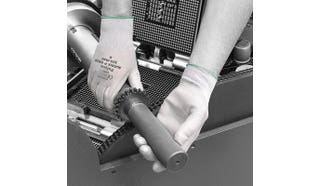
Hand Protection

Loading...

1305 Products Shown

Page
per page
Set Descending Direction

1305 Products Shown

Page
per page
Set Descending Direction

Hand Protection Gloves (PPE) Explored

Polyco Size 10/XL - SC104 Unlined Natural Rubber Chemical Protection Gloves - Black

As you will know, our hands are our most valuable tools, as we use them literally for everything, from operating complex machinery to carrying out delicate, precise tasks.

This is then no different in the workplace, as here they are constantly exposed to a wide range of hazards, from sharp edges, rough materials and cut protection gloves, to dangerous chemicals hand protection and extreme temperatures and more.

As a result, an injury to the hands can be debilitating, leading to time off work and a significant impact on quality of life, along with financial costs in compensation as well.

That’s why choosing the right-hand protection isn't just a box-tickling exercise; it's one of the most important health and safety decisions you can make when it comes to PPE.

But how do you go about choosing the right one for you?
Well, in this guide to hand protection PPE, we will walk you through everything you need to know on how to select the correct safety gloves for your needs, keeping your team safe and your workplace compliant.

So let’s make your workplace safer, comfier, and more protected — because a healthy body is the best tool you’ve got.

Then, if you are still not sure, our helpful customer service team is on hand to answer any questions you may have.

What are Hand Protection (PPE) Products?

Definition: In the UK, PPE hand protection refers to gloves, gauntlets, and protective sleeves engineered to shield workers from specific workplace hazards.

Governed by the Personal Protective Equipment at Work Regulations, its selection is a legal requirement dictated by a thorough risk assessment for each task.

As a result, all professional hand protection must be UKCA marked, certifying its compliance with designated technical standards, as these standards define their performance against identified risks: EN 388 rates mechanical resilience (abrasion, cut, tear, puncture); EN ISO 374 defines protection against chemical permeation; and EN 407/EN 511 cover thermal (heat/cold) hazards.

The correct specification is therefore critical for you to understand what you need for your applications, as your chosen glove will then provide you with adequate and certified protection against the specific dangers of the job at hand by doing so.

This will then help you to fulfil your employer's duty of care and safeguard your operator’s most valuable tools - their hands.

First, Understand the Risks

Before you can choose a glove, you actually need to know what you’re protecting against.

This is where risk assessment of the task and work environment is 100% needed before anything else.

Due to this, we find that most workplace hand hazards fall into one of these categories:

Mechanical Risks

The most common type of hazard is from mechanical risks, and this is where Mechanical glooves come in.

This category, for instance, tends to include cuts from sharp objects like metal or glass, abrasions from rough surfaces like bricks or concrete, and punctures from needles, splinters, or nails, to name a few here.

Chemical and Biological Risks

Handling oils, solvents, acids, cleaning agents, or other chemicals can then easily lead to burns, skin irritation, or long-term health problems.

Biological risks then can also involve exposure to bacteria, viruses, and other micro-organisms requiring more specialised chemical protective gloves.

Thermal Risks

Thermal gloves then cover both hot and cold hazards, and this could be contact with hot parts in welding or foundry work or working in cold environments like outdoor construction in winter or in refrigerated storage for instance.

Electrical Risks

A specialist hazard where there is a risk of electric shock, and in these situations, they will require specific insulating gloves and should not be confused with standard safety gloves.

What Are The Productivity Benefits of Proper Hand Protection?

Polyco Size 9/L - Tremor - Low X Black Seamless Knitted Shell Vibration Reducing Gloves

While health and safety compliance is the primary reason for using PPE, viewing hand protection solely as a requirement really does miss its main advantage - the right gloves are more of a powerful productivity tool to give you better results.

They manage to achieve this by:

Better Grip Means Better Control

As you will know well, many tasks, especially in engineering and assembly, involve handling components that may be small, smooth, or oily.

As a result, the right pair of gloves, particularly those with a sandy nitrile or micropore coating, provides a far superior grip than bare hands do.

This secure hold then means less fumbling tends to occur, fewer dropped parts, and a reduced risk of errors, as your workers can handle items more confidently and quickly - speeding up the entire process.

Modern Dexterity for Delicate Tasks

Long gone are the days of clumsy, thick gloves that make detailed work impossible.

Today, modern materials allow for gloves that are incredibly thin and flexible yet still offer excellent protection simultaneously.

For instance, a well-fitting glove with a Polyurethane (PU) coating, for example, allows workers to handle small nuts, bolts, and wires with precision. This eliminates the need to constantly remove gloves for delicate jobs, which not only saves time but also ensures protection is never compromised.

Comfort Reduces Fatigue and Increases Focus

An uncomfortable worker is a distracted and less productive worker. Gloves that are poorly fitted don't breathe well, or aren't suited to the temperature can cause significant discomfort over a long shift.

By contrast, a comfortable, well-fitting glove reduces hand fatigue, protects from vibration, and keeps hands warm and dry.

All in all, this will tend to allow your team to stay focused on the task for longer without needing to take breaks due to sore or tired hands.

The Reality of Workplace Hand Injuries, Why Protection Matters

In any busy workshop, warehouse, or on-site job, our hands are constantly on the front line. It’s easy to take them for granted until an injury occurs.

Unfortunately, these injuries are one of the most frequent and preventable problems in UK workplaces.

What The Numbers Say?

For instance from looking at statistics from the Health and Safety Executive (HSE) consistently show that injuries to the hands and fingers make up a significant portion of all non-fatal injuries reported each year.

For instance, according to the 2023/24 RIDDOR (Reporting of Injuries, Diseases and Dangerous Occurrences Regulations) data, injuries to the upper limbs (fingers, thumbs, hands, wrists, and arms) are the most common site of non-fatal workplace injuries, accounting for 37% of the total.

To break that down further:

  • Fingers and thumbs specifically accounted for 10% of all reported injuries
  • Hands accounted for another 7%

Therefore, injuries to the hands and fingers alone make up 17% of all non-fatal injuries reported by employers, confirming they are a very significant portion of the annual total as a result.

These aren't just minor cuts and scrapes; they include deep lacerations, chemical and thermal burns, debilitating skin conditions, and severe crush injuries that can have life-altering consequences.

Lost Working Days

Beyond the immediate pain for the individual, these incidents lead to thousands of lost working days every year, impacting business productivity and profitability due to this.

The crucial takeaway, however, is that safety experts agree the vast majority of these hand injuries could be easily avoided.

This is why a proper understanding of hand protection is not just a health and safety formality — it's key for both your team's well-being and your business's operational success as well.

Understanding EN Standards

When you look at a pair of safety gloves, be it non-disposable or disposable gloves, you'll see pictograms and codes printed on them, or the box.

As a result, these aren't just for decoration; they are your key to understanding what the glove is designed for and classed for use.

As a result, they refer to European Norm (EN) standards, which certify the glove's performance.

Here are the most important ones for you to know:

EN 388 - The Standard for Mechanical Risks

This is the most common standard you'll see, and it rates a glove's resistance to abrasion, cuts, tears, and punctures.

Here, the pictogram is a shield with numbers and letters below it.

Here’s what the ratings mean to you (for the EN 388:2016 standard):

Rating Position Protection Against Details
1st Number Abrasion Resistance Rated 1-4. Shows how well the glove stands up to rubbing and wear.
2nd Number Circular Blade Cut Resistance Rated 1-5. Shows how well it resists a circular blade.
3rd Number Tear Resistance Rated 1-4. Shows how much force is needed to tear the glove.
4th Number Puncture Resistance Rated 1-4. Shows how well it resists a standard-sized point.
5th Letter Straight Blade Cut Resistance (TDM Test) Rated A-F. This is a more accurate test for modern, high-performance, cut-resistant materials. 'A' is the lowest rating, and 'F' is the highest.
6th Letter Impact Protection If the glove passes the impact protection test, a 'P' will be shown at the end.

EN ISO 374, The Standard for Chemical & Micro-organism Risks

This standard then shows you how well a glove protects against chemicals, and it comes with a beaker pictogram that indicates the level of protection each glove gives you here.

For instance, here you have:

Type Minimum Permeation Time Minimum No. of Test Chemicals Level of Protection
Type A At least 30 minutes 6 chemicals Offers the highest level of protection against a broad range of chemicals.
Type B At least 30 minutes 3 chemicals Offers protection against a moderate range of chemicals.
Type C At least 10 minutes 1 chemical Offers limited protection, suitable for splashes only.

Pro Tip: The microscope pictogram, for instance, indicates the glove protects against bacteria and fungi.

EN 407 (Heat) & EN 511 (Cold)

These standards then relate to thermal hazards.

The EN 407 flame pictogram shows you ratings for things like flammability and contact heat.

Whereas the EN 511 snowflake pictogram shows your ratings for convective and contact cold.

How To Match the Glove to the Job?

Now you understand the risks and standards, you can choose the right type of glove for your application.

For instance, some things to consider are:

Type of Glove Key Materials & Features Best For...
Cut-Resistant Gloves Made from HPPE (High-Performance Polyethylene), steel fibre, or glass fibre, it often has a nitrile or PU coating for grip. Handling sheet metal, glass, sharp-edged components, construction, and waste management. Look for a high EN 388 cut rating (D, E, or F).
General Handling Gloves Typically made from nylon or polyester with a PU, Nitrile, or latex coating on the palm for excellent grip and dexterity. Warehouse work, assembly, automotive maintenance, general building work. Often called "mechanic's gloves."
Chemical-Resistant Gloves Made from Nitrile, Neoprene, PVC, or Latex, the material choice here depends entirely on the chemical being handled. Laboratory work, industrial cleaning, chemical manufacturing, oil and gas industries, and you should always check the chemical compatibility chart.
Leather Gloves Tough and durable, offering you good abrasion resistance, which is often used for heavy-duty tasks, and can also include rigger gloves. Welding, construction, forestry, agriculture, and general heavy handling.
Thermal Gloves (Hot & Cold) For heat, materials including leather, Kevlar®, and aluminised fabrics can be used, whereas, for cold environments, they will have an insulated thermal lining. Hot: Welding, foundry work, bakeries.
Cold: Cold storage, outdoor winter work, construction.
Disposable Gloves These then tend to be thin, single-use gloves made from Nitrile, Latex, or Vinyl, and Nitrile is the most popular choice due to its strength and allergy-free properties. Food handling, cleaning, laboratory work, medical applications, tasks requiring protection against light splashes and contaminants.

A Simple, Step-by-Step Guide to Choosing Your Gloves

Choosing the right-hand protection can feel complicated, but it doesn't have to be.

To help you here, we have created a logical process that will allow you to systematically narrow down the options you need and find the perfect glove for the job.

For instance, here you should:

Step 1 - Assess the Task and Identify Your Hazards

Tornado Gloves Size 9/XL Oil Teq 1 Seamless Nylon Cut Resistance Gloves

Before looking at any gloves, you should start by looking closely at the job itself and ask yourself simple questions to build a clear picture of the risks involved.

Are you handling materials with sharp edges, like glass or sheet metal?
Are you working with liquids, and if so, are they oils, water, or specific chemicals?
Is there a risk of heat, cold, or abrasion from rough surfaces?

Here, you need to list every potential hazard you can identify.

Step 2 - Match the Hazards to the EN Standards

Once you know your hazards, you can then look for gloves that are certified to protect against them.

This is where the EN standards are essential because if cut protection is your main priority, you need to find a glove with a suitable EN 388 cut rating (A).

If you identify a chemical hazard, you must check the glove's EN ISO 374 rating to ensure it’s suitable for the specific substance you're using, for instance.

Matching the hazard to the standard you need, though, is the most critical step for ensuring that you get worker safety, as a glove that doesn't even align with the standard you need really is no good.

Step 3 - Think About the Job's Practical Needs

A glove is only effective if it allows the worker to do their job properly.

Now, you need to consider the practical side of the task.

How much dexterity is needed?

If the job involves handling small nuts and bolts, you’ll need a thin, flexible glove that provides adequate protection, likely with a PU coating.

If you’re handling oily parts, you’ll need an excellent grip from something like a sandy nitrile coating, though.

As a result, here you should think about comfort, too – will the gloves be worn for a full eight-hour shift?

Step 4 - Confirm the Fit and Get Feedback

An ill-fitting glove can be unsafe and unproductive.

As a result, you need to use a manufacturer’s sizing chart to get the right size for your team members.

A glove that is too loose can snag on machinery, while one that's too tight will be uncomfortable and restrict movement.

If possible, also order a sample pair to try with the people who will be wearing them every day, as their feedback really is invaluable for ensuring the gloves are both safe and practical for the long term.

Step 5 - Balance Cost Against Performance and Lifespan

Finally, consider your budget.

While it’s tempting to go for the cheapest option, it’s important to think about long-term value and long-term protection.

A slightly more expensive, durable glove may actually last significantly longer than a low-cost alternative, making it more cost-effective over time.

As a result, you need to consider the lifespan of the glove in relation to the task you need it for.

Then, for tasks with a high risk of contamination or for light-duty work, a disposable glove may be the most sensible and economical choice for you here as well.

Don't Forget Fit, Comfort, and Care

Even the best safety glove in the world is useless if it’s not worn or worn correctly.

As a result, to make sure you get the right gloves for your team, always remember:

Get the Right Size

There is no such thing as one glove fits all. Here, a glove that’s too big will reduce your workforce's dexterity and could get caught in machinery, leading to injury.

A glove that’s too tight will be uncomfortable and restrict blood flow, and will tend not to be used as often as it should by your operators.

As a result, you want to use a sizing chart to ensure every team member has the right fit for what they need to do.

Consider the Coating

A sandy Nitrile coating can provide excellent grip in oily conditions, while a Polyurethane (PU) coating will offer you great dexterity for delicate tasks.

As a result, you really need to align the coating of the glove to the application you need it for as well, as the wrong coating here can make the glove totally impractical for the level of safety it needs to provide here.

Inspect Before Use

You should also always check gloves prior to use for holes, rips, or signs of degradation before starting work.

This is especially needed for chemical-resistant gloves, as prior chemical exposure may have weakened the glove, making it need to be replaced before you can use it again.

Know When to Replace Them

All gloves wear out, and a heavily worn glove will not provide its certified level of protection.

As a result, you want to replace gloves regularly, and whenever damage is found on them - don't wait. In this case, replace them.

So is Hand Protection Right For You?

As you can see, by taking the time to assess the risks and understand the features of the gloves available, you can really make sure your hands —and those of your team — are fully properly protected, day in and day out.

So are you ready to find the right protection?
Browse our full range of certified safety gloves above, and if you are not sure, our customer service team is here to help.

Contact Customer Support

If you are still not sure about which is the correct PPE protection product for you, or you need help, then for further product information , please contact our team, and we will be happy to help you understand which ones are perfect for you and your team.

MSC Direct's team

Standard Delivery Options

We have also extended our delivery service and ordering hours to offer you free next-working-day delivery with immediate despatch, making your shipping experience even easier.

Place your order online by 7 p.m. and choose the delivery charge that suits you - including next-day dispatch - to ensure you get a timely, UK mainland hassle-free delivery of your products.

Standard free UK delivery is also available for all products ordered within the specified time, with free shipping and a good returns policy for certain items as well.

Who Is MSC Industrial Supply Co.?

Here at MSC Industrial Supply Co., we are a leading supplier of industrial machine tools, equipment, and maintenance supplies across the United Kingdom. As a result, we can offer trade accounts, a vast selection of new and great-value products from tool sets to metalworking cutting tools and lots more, with free next-day delivery on eligible orders as well.

Our extensive range includes everything from hand tools and power tools to specialised hole-making equipment like blacksmith drill bits, core drills, and machine reamers, to name just a few.

As a result, we can provide you with a comprehensive selection of products, including:

As a result, we serve a wide range of industries, from manufacturing and engineering to maintenance and beyond. Consequently, our commitment to providing quality products and exceptional customer service makes us a trusted partner for all your industrial needs.

With our knowledgeable customer support team and technical assistance available Monday-Friday, we ensure you have the support you need to succeed.